Mesmerismus Research Institute
The Magnetic Library
The Magnetic Library is the institute’s collection of historical sources on animal magnetism, early hypnosis and the fields that grew around them. It exists so that every question we ask about the body can be checked against what the first observers actually wrote.
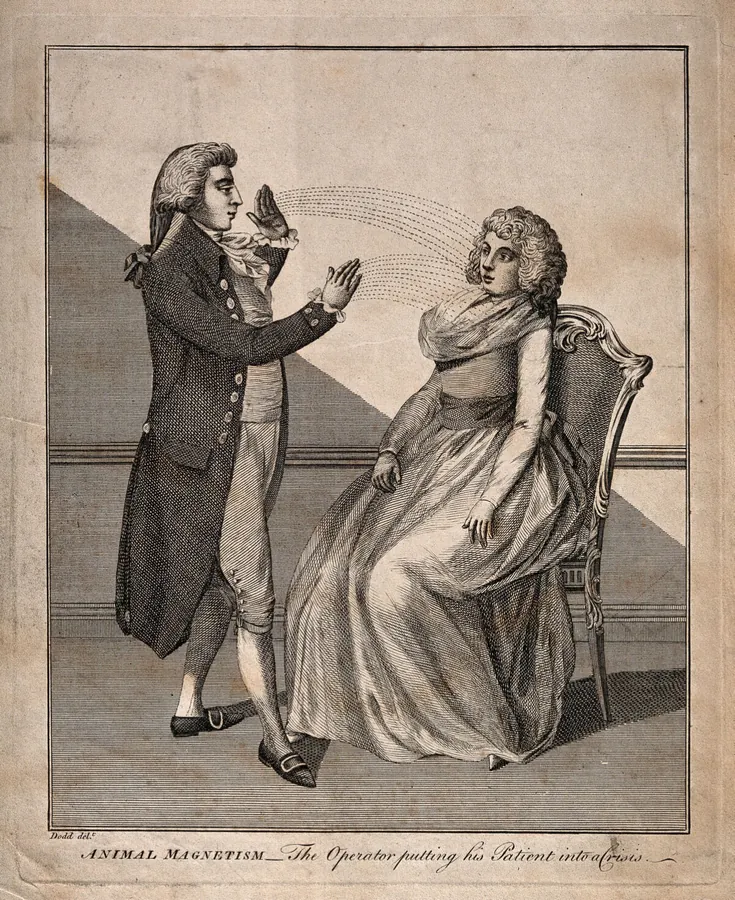
Scope
The Library covers the literature of animal magnetism from its beginnings in 1766, the year of Mesmer’s medical thesis, through magnetism, somnambulism, early hypnotism and psychical research, with later works that discuss these traditions. It includes books, pamphlets, periodicals and other documents, in their original languages.
Figures as of 26 October 2026, from the Library’s own catalogue.
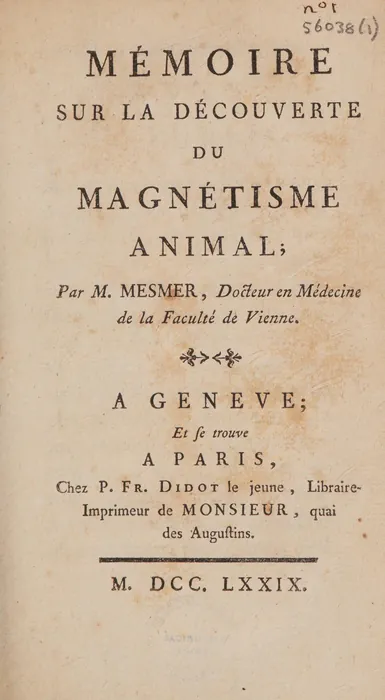
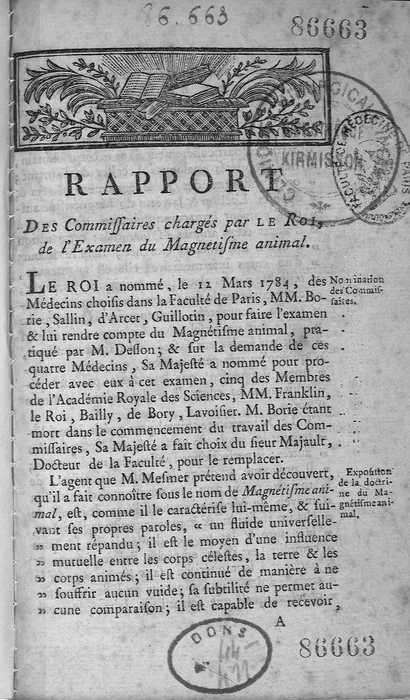
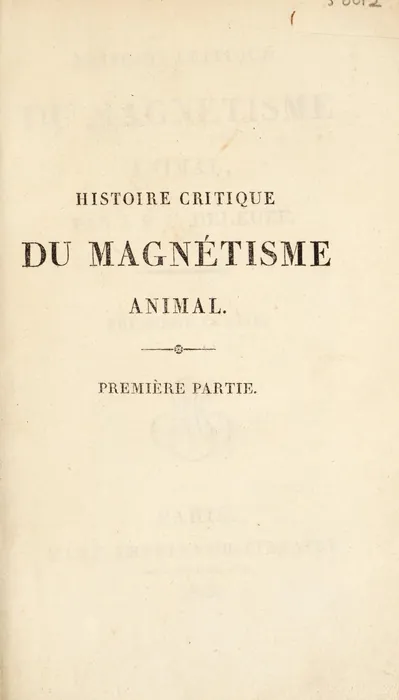
The Library catalogues 4,841 items on animal magnetism, hypnotism, somnambulism, fascination and psychical research, about 4,050 of them with fully readable digitised text. Compared with the reference bibliography by Adam Crabtree (about 1,900 entries), about 490 works are identified with certainty and about 660 in total: more than a third of the bibliography, and about half of the entries it lists for 1766–1849. The catalogue also holds many books, pamphlets and periodical issues of the same period that are not linked to any Crabtree entry. We are examining them one by one: each work confirmed as absent from Crabtree’s bibliography enters the index with its own note. Overall the digital collection counts over 13,700 documents in more than 10 languages.
Method
Our method follows the model of a reference bibliography widely used by historians of hypnosis. Adam Crabtree, a Canadian psychotherapist and historian of psychology, published in 1988 Animal Magnetism, Early Hypnotism, and Psychical Research, 1766–1925: An Annotated Bibliography, which lists and comments about 1,900 works in chronological order. We use it as a grid: each document in the Library is identified as a distinct text (the same work may exist in several editions or copies), compared with Crabtree’s entries, and described. Each work receives a permanent reference code (e.g. BM-1784-012); matches with Crabtree are verified by rule-based comparison and a second independent check.
The period index
The period index is the public face of the Library: for each historical period, a card for every relevant work, with three kinds of judgement side by side. The first records what historians have said about the work; the second gives Crabtree’s annotation where one exists; the third is a note of the Library, written by us after reading the source. The index is in progressive publication, period by period.
- 1766–1784 · Mesmer and the first commissions coming
- 1784–1815 · Puységur and magnetic somnambulism coming
- 1815–1841 · The magnetic societies and the second Paris inquiry coming
- 1841–1882 · Braid, hypnotism and the spread across Europe coming
- 1882–1925 · Nancy, the Salpêtrière and psychical research coming
Work of the month
Every month the Library presents one work, with what its contemporaries said about it.
Instruction pratique sur le magnétisme animal
J. P. F. Deleuze · Paris: Dentu, 1825 · Crabtree no. 320
What its contemporaries said
«L’Instruction pratique de M. Deleuze est un livre dont je recommande la lecture à tous ceux qui n’ont aucune idée du magnétisme.»Translation: “Mr Deleuze’s Instruction pratique is a book whose reading I recommend to all those who have no idea of magnetism.”Aubin Gauthier, Traité pratique du magnétisme (1845)
“…the Instruction Pratique of the excellent and sober-minded Deleuze is the first book that I should recommend.”George Sandby, Mesmerism and its Opponents, 2nd ed. (London: Longman, 1848), preface, pp. xiii–xiv
Note of the Library
A clear practical manual built on simple, tested procedures; it places the goodwill and steady intention of the practitioner at the centre of the work.
Access
Researchers can apply for access to the Library as Visiting Scholars. Access is granted on the basis of a short research proposal.