How it began: the founder’s account
It began in 1990, in a barber's shop in Castellamonte, a small town in Piedmont. A friend of Dr. Marco Paret went there to ask the barber, Virgilio T., what hypnotism really was. Instead of answering, Virgilio closed the door and fixed his gaze on one of the waiting customers. Within seconds the man's defiant expression gave way, his face turned pale as wax, and at a single remark about his cigarette he was seized by a fit of coughing. A second customer, without a word being spoken, sank into the same strange stillness.
Dr. Paret did not believe the story until he saw it for himself, and then felt it on himself. Together with his friend he became Virgilio's student. Virgilio had learned the method as a boy from a man called Rolando, and it appeared to descend from the "fascination" of Donato, the Belgian magnetiser who in the 1870s could stop a person with a single look. Soon after, in Milan, Professor Erminio Di Pisa, who called the same art "instant hypnosis", showed them how the gaze could be used not as a show but to help people, in a few seconds.
On the same day that his research into hypnosis began, a second research began too: how to interpret what he had seen. From the start Dr. Paret looked for the answer in the neurosciences and in NLP, which were then opening new ways of describing how people influence one another. The practice of the gaze and its scientific interpretation have grown side by side ever since; they are the two halves of this institute.
In the years that followed, Dr. Paret looked for the same instant gaze in the Americas, Brazil, Indonesia, Australia and Russia, and did not find it elsewhere in that form. Two questions remained. Where did this knowledge come from? And what happens in the body of a person who is stopped by a gaze? The Magnetic Library grew from the first question: finding, in the books of the old magnetisers, the scenes we had witnessed in a barber's shop. The Audiovisual Observatory grew from the second: filming, course after course, what the gaze does to the human body.
Where the story begins
Animal magnetism was born in Europe in the eighteenth century, when physicians observed that one person’s presence, gaze and slow hand movements could produce strong bodily reactions in another: changes in breathing, warmth, trembling, deep relaxation, sometimes a sudden release of tension that they called the “crisis”. Franz Anton Mesmer, a Viennese physician working in Paris, gave the practice its first name and its first theory.
In the nineteenth century hypnosis became verbal. Practitioners began to induce trance mainly through words and instructions, and the bodily phenomena of the magnetisers were reinterpreted as “suggestion”: an effect of expectation and of language. Much of what the early observers had described in the body was left aside.
We put the body back at the centre. Our starting point is what the body visibly does when a person is approached, looked at or touched without words, and we read it alongside the original documents of those who first described it.
What makes the institute specific
The institute rests on two resources. The first is the Magnetic Library, a collection of 4,841 catalogued items on animal magnetism, hypnotism and related fields, with over 13,700 documents in its digital collection. The second is the Audiovisual Observatory, an archive of courses and demonstrations filmed from 2011 to 2026, drawn from more than thirty years of practice.
Mesmerismus® is a registered trademark of Dr. Marco Paret, who created it and who directs the foundation. The name identifies his approach to non-verbal hypnosis, which the institute documents and studies.
Human and animal hypnosis: one paradigm
In 1938 the Hungarian physician and psychiatrist Ferenc András Völgyesi (1895–1967) published Menschen- und Tierhypnose (Zürich and Leipzig: Orell Füssli), a book on the hypnosis of humans and animals translated from his Hungarian work Ember és állat hypnosis and later translated into English as Hypnosis of Man and Animals, with special reference to the development of the brain in the species and in the individual (London, 1966). He photographed lobsters, birds, crocodiles, bears, lions and monkeys in hypnotic catalepsy, and he drew a bold conclusion: hypnotic states in humans and animals share a common biological origin, so words are not the only way to induce them, and non-verbal techniques can work in people too.
After Völgyesi the question was split in two. Biologists went on studying tonic immobility in animals; psychologists studied suggestion in humans. We take up his question again, with a different instrument. We start from non-verbal induction — gaze, presence, magnetic passes — and we observe in people, across fifteen years of filmed courses and demonstrations (2011–2026), responses that closely resemble those of tonic immobility in animals: sudden stillness, catalepsy, changes in muscle tone and breathing, and the release that follows.
In plain words: the body has an ancient way of stopping and protecting itself, and the same way can open into calm and recovery. Scientifically one would say that we study a defensive and regulatory response of the autonomic nervous system, which neuroscience links to the periaqueductal grey and to vagal regulation of the heart (Kozlowska et al., 2015), and which non-verbal hypnosis may be able to evoke without words — this is one of our research questions. This is the line of research that defines our institute.
This is what we mean by a neurofunctional approach: we begin from the function we can observe in the body, and then ask which neural systems sustain it, rather than starting from a single theory of suggestion.
Two paradigms, re-founded
Polyvagal theory and neuro-linguistic programming (NLP) are two of the frameworks most widely used by practitioners who work with people, and two of the most criticised by researchers. We propose to re-found both on a more scientific basis: starting from observable function and from the relationship between people, keeping what holds and testing the rest.
A neurofunctional reading of polyvagal theory
Polyvagal theory, proposed by the American neuroscientist Stephen Porges, has given therapists a simple map of the nervous system: a state of safety and social engagement, a state of mobilisation for fight or flight, and a state of immobilisation and shutdown. It also gave a name to something every practitioner of non-verbal hypnosis knows well: neuroception, the body's automatic sense of safety or danger, before any thought.
The theory has also been criticised. In 2023 the psychophysiologist Paul Grossman examined its five basic premises — the distinct roles of the dorsal and ventral vagal nuclei, their link with defensive immobilisation and social behaviour, their evolutionary sequence, and the use of respiratory sinus arrhythmia as an index of vagal tone — and judged them untenable or highly implausible.
Our approach keeps what can be observed and leaves open what is still disputed. We use the three states and neuroception as functional descriptions of what the body does: when a person freezes, softens, breathes differently or lets go, we record it as a change of state, whatever the anatomy behind it. We do not rest our work on the contested premises: we do not assume which vagal nucleus is responsible, we do not reconstruct an evolutionary ladder, and we do not treat a single heart-rate index as a measure of the vagus. The anchor comes from elsewhere — from tonic immobility, a defensive response studied for more than a century in animals, and from what fifteen years of filmed observation (2011–2026) show in people.
Put simply: the map remains useful, and we test it on the ground. Scientifically one would say that we treat polyvagal states as hypotheses about function, to be checked against observable behaviour and against several physiological measures together, rather than as established neuroanatomy. This is the bridge we offer between practitioners who find the theory helpful and researchers who question its foundations.
Mesmeric Polyvagal Therapy — the director’s practice site (not a research output).
From techniques to relationship: NLP re-founded
Neuro-linguistic programming was developed in California in the 1970s by its pioneers Richard Bandler and John Grinder, who modelled how outstanding therapists worked with their clients. It spread worldwide as a practical toolkit for communication. Dr. Marco Paret was among those who introduced it in Italy, and for decades he has applied it in consulting for companies and institutions.
Research has been severe with some of its claims. A 2010 review of 33 studies by the psychologist Tomasz Witkowski found that most did not support NLP's tenets, in particular the idea that each person has a preferred sensory system that can be read from eye movements and choice of words.
In classical NLP, communication builds the relationship: the practitioner uses words and techniques to create rapport. We reverse the order. For us the relationship is the space in which communication is built, and that space is made first of non-verbal elements — presence, gaze, posture, rhythm, breathing — before any word is spoken.
What practitioners call rapport — the moment two people begin to move, breathe and respond in tune — is studied today as interpersonal synchrony: a 2017 systematic review describes how the autonomic signals of two people can become interdependent, and how this is linked to the quality of their relationship. Here NLP meets non-verbal hypnosis and the polyvagal idea of co-regulation.
In plain words: what changes a person is less a technique applied to them than the quality of the bond in which it happens. Scientifically one would say that we take the relationship as the unit of analysis, and we test NLP procedures by their effect on observable synchrony and regulation between two people, keeping what holds and leaving aside what research has not confirmed. In our school this approach is called NLP3: it brings together NLP, non-verbal hypnosis and polyvagal regulation.
A neurofunctional approach
A neurofunctional approach starts from an observed function of the body and looks for the mechanisms that produce it. We begin with the phenomenon as it appears (a fixed gaze, a sudden stillness, a change in muscle tone) and only then ask which systems are involved: the autonomic nervous system, which regulates heart rate, breathing and digestion without our will; micromovements, the small involuntary movements of muscles and eyes; and tone, the resting tension of the muscles.
Research agenda: open questions
Our research agenda is written as questions, because each one marks a point where the historical record and present-day physiology have not yet met.
- Human and animal hypnosisAre tonic immobility in animals and non-verbal hypnotic catalepsy in humans expressions of the same neural response?
- Polyvagal states as functional hypothesesCan changes of state during non-verbal induction be identified reliably from behaviour and from several physiological measures together, independently of any single index of vagal tone?
- Rapport as interpersonal synchronyDoes non-verbal induction increase measurable behavioural and physiological synchrony between practitioner and subject, and does this predict the outcome?
- Gaze and fascinationFascination is the old name for an induction made through the gaze alone. Which changes in attention, blinking and posture follow a sustained gaze, and in what order?
- Catalepsy and tonic immobilityCatalepsy is a state in which the limbs stay in the position they are placed in; tonic immobility is the “freezing” response studied in animals. How far do these two descriptions refer to the same mechanism in humans?
- Magnetic passes and touchPasses are slow movements of the hands along the body, at a distance or with light contact. Which sensory channels (skin, temperature, vision of the movement) carry their effect?
- The mesmeric crisisThe early magnetisers saw the crisis as a natural resolution: a discharge after which tension fell. Can it be described as an autonomic response that restores balance?
- Verbal and non-verbal inductionWhen the same person is guided into trance with words and without words, which bodily responses differ, and which remain the same?
- The polyvagal lensPolyvagal theory, proposed by the American neuroscientist Stephen Porges, describes how the nervous system detects safety or danger below awareness, a process he calls neuroception. Does it help explain why a calm presence can change another person’s state?
Presentations and congresses
Dr. Marco Paret presents the institute's themes at international and medical conferences. The list below includes only interventions documented by a public source.
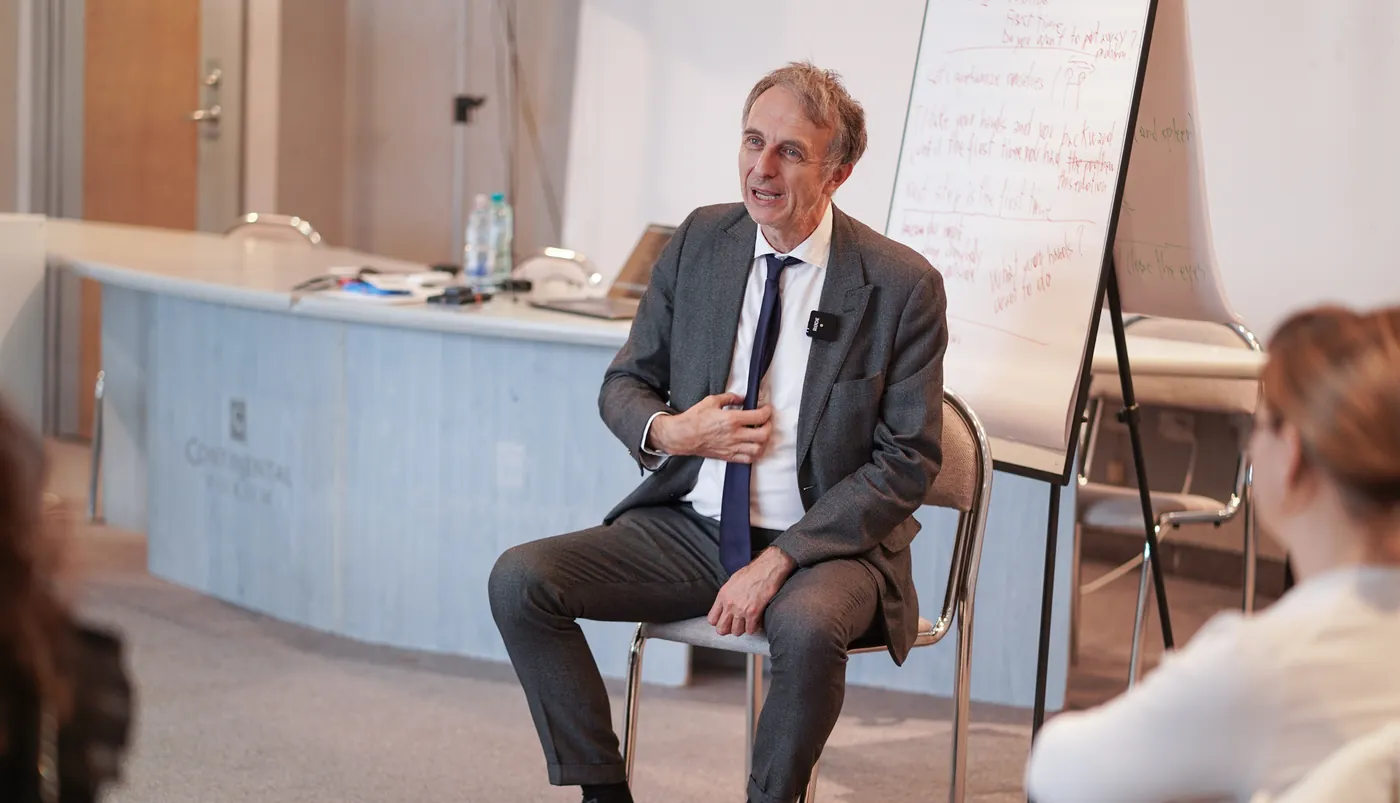
- Timișoara, Romania, 11–13 September 2025 · National Conference of Psychiatry with international participation, plenary session “Hypnosis in psychiatric practice”. With Prof. Dr. Adrian Bumbu: “Neurophysiological mechanisms of gaze-induced trance: perspectives on hypnotic fascination and polyvagal theory” and “Mesmerism – practical aspects: demonstration of non-verbal induction techniques”. Programme (PDF) · conference page
- Oradea, Romania, 1–3 March 2024 · Congress “Psychotherapeutic Orientations in Modern Psychiatry”, Hotel Continental. President of the scientific committee; talks “Using mesmeric crisis for solving problems” and “Fascination techniques”, and a workshop “Basic training in non-verbal hypnosis”. Congress page
- Rome, Italy, 2016–2019 · World Congress of Hypnosis (Congresso Mondiale di Ipnosi), conceived and directed by Dr. Marco Paret (organised by Ipnosi Italia, I.P.C.A., an association connected with the director): 17–19 June 2016, 16–18 June 2017, 15–17 June 2018, 21–25 June 2019. His talks included “Fascination for personal development and leadership” (2016) and “Hypnosis and Mesmerismus” (2018). Editions · 2016 report · 2018 report
- Monte-Carlo, Monaco, 15–16 November 2011 · International Conference of Human Resources, Grimaldi Forum, with Matt Traverso. Archived event page
What exists, and what is in preparation
Each part of the institute has its own stage of development, shown here as it stands today.
| Magnetic Library | in place Catalogue of historical sources; period index in progressive publication. |
|---|---|
| Audiovisual archive | in place Courses and demonstrations filmed 2011–2026; phenomenological catalogue in progress. |
| Method and practice | in place Decades of direct practice and teaching of non-verbal hypnosis. |
| Scientific committee | in formation Members will be announced on this site. |
| Annals of the institute | planned Papers with a DOI; peer review will start once the scientific committee is in place. |
One question stays with us through every source we read: why did observers of the 1780s, without any notion of the autonomic nervous system, describe so precisely the responses that physiology names today?
Key terms
- Non-verbal induction
- Guiding a person into a hypnotic state through gaze, presence, touch or passes, without verbal suggestion.
- Fascination
- The historical name for an induction made through a sustained gaze.
- Animal magnetism
- The practice founded by Franz Anton Mesmer in the eighteenth century, which acted on the body through presence, passes and touch.
- Tonic immobility
- A defensive “freezing” response in animals, in which the body becomes still and rigid for a time.
- Neuroception
- Stephen Porges’s term for the body’s automatic sense of safety or danger, before any thought.
- Neurofunctional approach
- Starting from a function observed in the body, and then asking which neural systems sustain it.
- Interpersonal synchrony
- The coordination of movement, breathing and physiological signals between two people.
- NLP3
- The School’s approach that brings together NLP, non-verbal hypnosis and polyvagal regulation.
- Mesmerismus®
- The registered trademark of Dr. Marco Paret and the name of the method he created.
References
- Völgyesi F. A., Hypnosis of Man and Animals, 2nd ed., trans. M. W. Hamilton, London: Baillière, Tindall & Cassell, 1966. Wellcome Collection catalogue
- Völgyesi F. A., Menschen- und Tierhypnose, Zürich and Leipzig: Orell Füssli, 1938. Google Books record
- Gyimesi J., “Hypnotherapies in 20th-century Hungary: The extraordinary career of Ferenc Völgyesi”, History of the Human Sciences 31(4), 2018, 58–82. doi:10.1177/0952695118790414
- Porges S. W., The Polyvagal Theory: Neurophysiological Foundations of Emotions, Attachment, Communication, and Self-regulation, New York: Norton, 2011.
- Grossman P., “Fundamental challenges and likely refutations of the five basic premises of the polyvagal theory”, Biological Psychology 180, 2023, 108589. doi:10.1016/j.biopsycho.2023.108589 (preprint, CC BY)
- Witkowski T., “Thirty-five years of research on neuro-linguistic programming. NLP research data base. State of the art or pseudoscientific decoration?”, Polish Psychological Bulletin 41(2), 2010, 58–66. doi:10.2478/v10059-010-0008-0 (record)
- Kozlowska K., Walker P., McLean L., Carrive P., “Fear and the Defense Cascade: Clinical Implications and Management”, Harvard Review of Psychiatry 23(4), 2015, 263–287. doi:10.1097/HRP.0000000000000065
- Palumbo R. V. et al., “Interpersonal autonomic physiology: a systematic review of the literature”, Personality and Social Psychology Review 21(2), 2017, 99–141. doi:10.1177/1088868316628405 (record)